
Mã tài liệu: 301866
Số trang: 45
Định dạng: rar
Dung lượng file: 368 Kb
Chuyên mục: Sư phạm
[FONT=Times New Roman]INTRODUCTION
1. Rationale
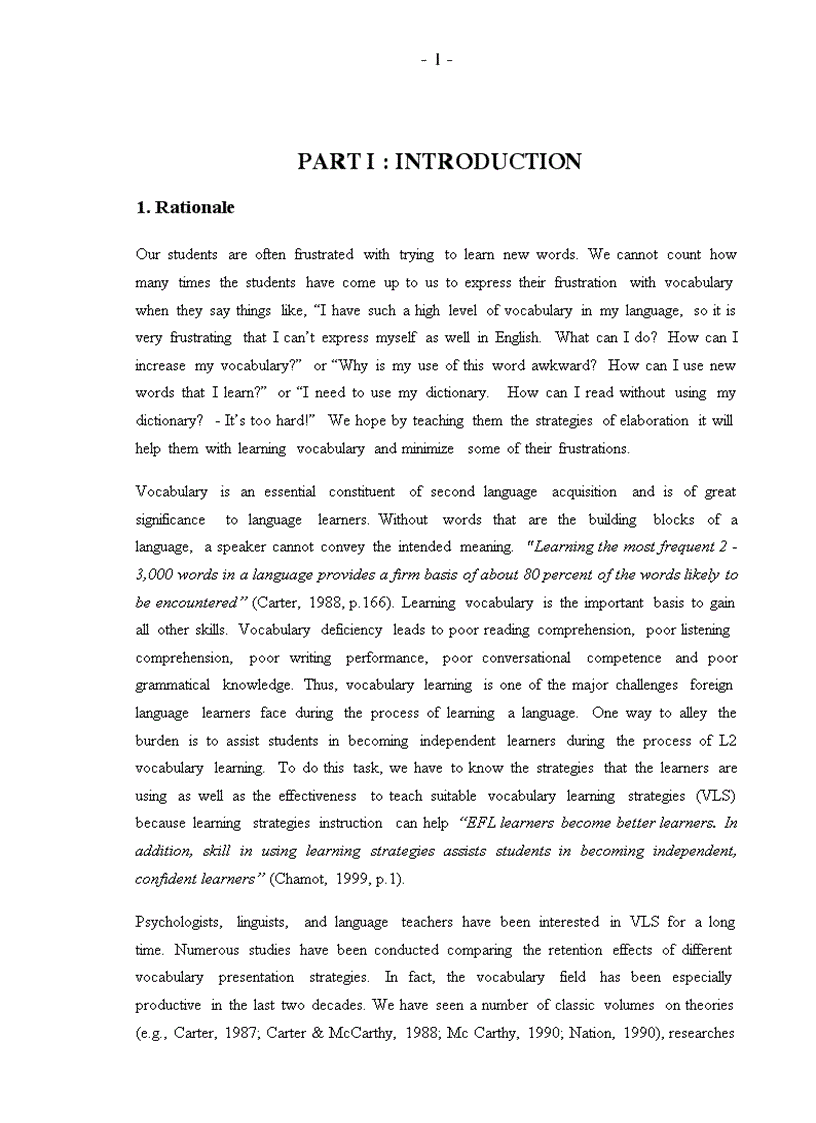
Our students are often frustrated with trying to learn new words. We cannot count how many times the students have come up to us to express their frustration with vocabulary when they say things like, “I have such a high level of vocabulary in my language, so it is very frustrating that I can’t express myself as well in English. What can I do? How can I increase my vocabulary?” or “Why is my use of this word awkward? How can I use new words that I learn?” or “I need to use my dictionary. How can I read without using my dictionary? - It’s too hard!” We hope by teaching them the strategies of elaboration it will help them with learning vocabulary and minimize some of their frustrations.
Vocabulary is an essential constituent of second language acquisition and is of great significance to language learners. Without words that are the building blocks of a language, a speaker cannot convey the intended meaning. "Learning the most frequent 2 - 3,000 words in a language provides a firm basis of about 80 percent of the words likely to be encountered” (Carter, 1988, p.166). Learning vocabulary is the important basis to gain all other skills. Vocabulary deficiency leads to poor reading comprehension, poor listening comprehension, poor writing performance, poor conversational competence and poor grammatical knowledge. Thus, vocabulary learning is one of the major challenges foreign language learners face during the process of learning a language. One way to alley the burden is to assist students in becoming independent learners during the process of L2 vocabulary learning. To do this task, we have to know the strategies that the learners are using as well as the effectiveness to teach suitable vocabulary learning strategies (VLS) because learning strategies instruction can help “EFL learners become better learners. In addition, skill in using learning strategies assists students in becoming independent,
Psychologists, linguists, and language teachers have been interested in VLS for a long time. Numerous studies have been conducted comparing the retention effects of different vocabulary presentation strategies. In fact, the vocabulary field has been especially productive in the last two decades. We have seen a number of classic volumes on theories (e.g., Carter, 1987; Carter & McCarthy, 1988; Mc Carthy, 1990; Nation, 1990), researches (e.g., Arnaud & Bejoint, 1992; Gass, 1987; Meara, 1989; Nation & Carter, 1989), and practical tips (e.g., Gairns & Redman, 1986; McCarthy & O'Dell, 1994). Recent volumes shed significant light upon different aspects of vocabulary acquisition include Huckin, Haynes, and Coady (1993), Harley (1995), Hatch and Brown (1995), Coady and Huckin (1997), Schmitt and Mc Carthy (1997), Atkins (1998), Wesche and Paribakht (1999), Read (2000), Schmitt (2000), and Nation (2001). These researches solved the present problems.
Hence, based on the significance attributed to VLS in the process of vocabulary learning and enhancement, this research aims at studying on the effectiveness of Cognitive Strategies (CS) in learning vocabulary.
2. Aims of the study
The aim of this study is to introduce CS into vocabulary learning syllabus at Nghe An Continuing Education Center (NACEC) so that we can examine the effectiveness of those strategies and to elicit students' opinions about the application of CS. From these aims, this study was an attempt to meet the need of the students at NACEC for an alternative way to improve their vocabulary learning ability. It was expected that the results of this study would serve as a useful source of reference for the teachers and administrators at NACEC.
To gain the aims which are mentioned above, this study was designed to test the following hypothesis:
H1: Students who take part in the application of CS in learning vocabulary will make more improvement in vocabulary ability than those who do not participate in such a program.
The acceptance of this hypothesis would result in the rejection to the following null hypothesis or vice versa:
H0: There is no difference in vocabulary proficiency as measured by a proficiency test between students who take part in the experiment program and those who do not.
In order to draw the conclusion on which hypothesis would be accepted, the answers to the research questions presented below would be found:
Is there a significant difference in using CS to learn vocabulary between the control group (students who do not participate in applying program of CS) and the experimental group (students who participate in the program)?
Do CS make the students' vocabulary learning ability improved?
What are the students' opinions about CS and their suggestions for future programs?
The first and the second questions are the focal points. The answer to them would yield empirical evidence for the effectiveness of CS in learning vocabulary. The answer to the last question would provide invaluable information about students' evaluation of CS necessary for further application.
3. Scope of the study
Given the time constraint, the study was conducted on the 1st non-English students at NACEC only. The thesis limited itself to the experimental research of CS in learning vocabulary to find out their effectiveness. This means the study was not extended to measure students' common VLS. Therefore, data for analysis were collected from those students in the researcher's hope of gaining a better understanding of the issue in consideration.
4. Method of the study
The main research method employed in this study to find out the answers to the proposed research questions within the scope of the study is a quasi-experimental design which involves the three basic components of experiments as presented by Selinger and Shohamy, that is, the population (1st students at NACEC), the treatment (CS) and the measurement of the treatment (t-test) (1989, p.136).
Beside this main method, a questionnaire was also delivered to the students taking part in applying program of CS as a complementary tool to obtain their feedback on the program and their suggestions for future programs.
5. Design of the study
The study comprises three main parts:
Part I: Introduction
This part discusses the rationale, aims, scope, an overview of the research method and the design of the study.
Part II: Development
This part is divided into four chapters:
Chapter 1: presents a brief theoretical background for the thesis
Chapter 2: presents a detailed discussion of the method used in the study with all of its components encompassing the justification for using the quasi-experimental design, the participants, the design of the pretest and posttest.
Chapter 3: is the most important part of the study presenting significant findings and discussions of the study.
Chapter 4: presents some pedagogical implications derived from the main findings and some suggested vocabulary practicing activities.
Part III: Conclusion
This part summaries the main findings and points out some limitations of the study that serve as the basis for the researcher’s suggestions for further study.










Những tài liệu gần giống với tài liệu bạn đang xem
Những tài liệu bạn đã xem
 The 11th form non english majors level of satisfaction with their reading comprehension lessons at phan boi chau specialized upper secondary school
[FONT=Times New Roman] INTRODUCTION 1. Rationale Our students are often frustrated with trying to learn new words. We cannot count how many times the students have come up to us to express their frustration with vocabulary when they say things
zip Đăng bởi
tamheou
The 11th form non english majors level of satisfaction with their reading comprehension lessons at phan boi chau specialized upper secondary school
[FONT=Times New Roman] INTRODUCTION 1. Rationale Our students are often frustrated with trying to learn new words. We cannot count how many times the students have come up to us to express their frustration with vocabulary when they say things
zip Đăng bởi
tamheou