
Mã tài liệu: 270902
Số trang: 15
Định dạng: zip
Dung lượng file: 74 Kb
Chuyên mục: Tổng hợp
PART A: INTRODUCTION
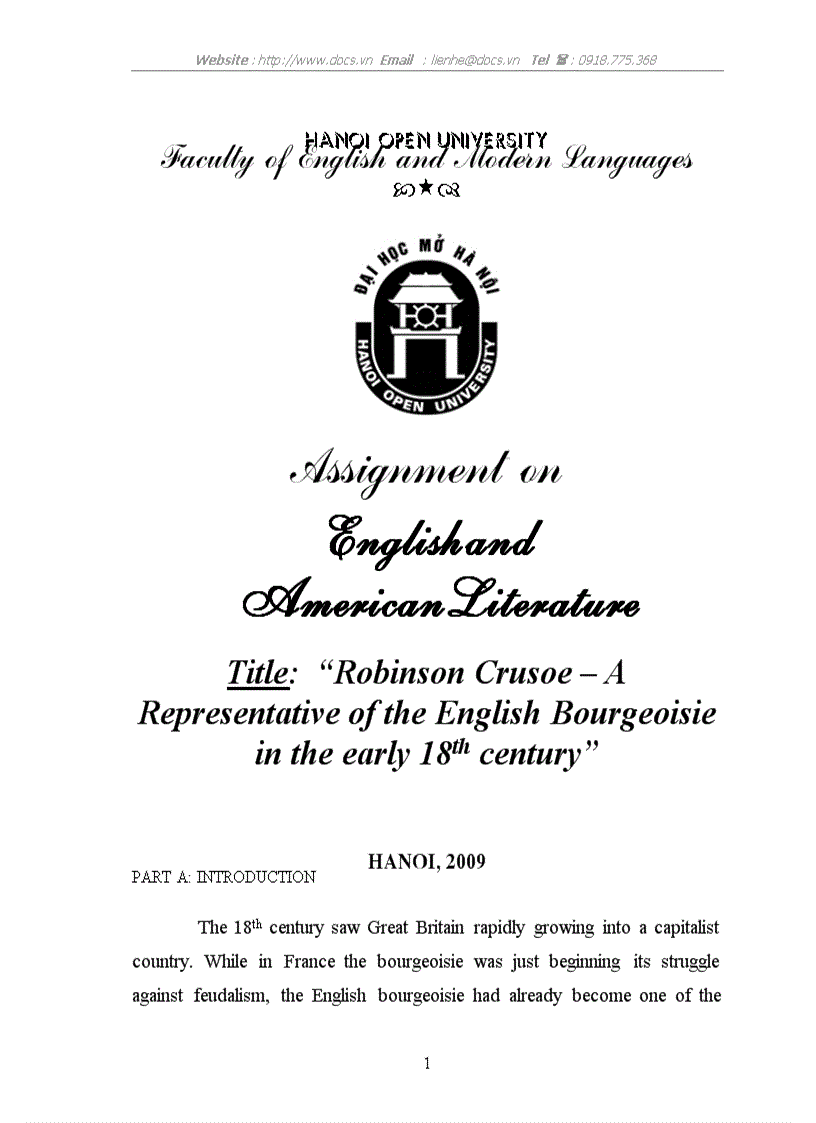
The 18th century saw Great Britain rapidly growing into a capitalist country. While in France the bourgeoisie was just beginning its struggle against feudalism, the English bourgeoisie had already become one of the ruling classes. In reality, the phenomena” land hedging and soil plundering” occurred. Farmers were driven out of their own lands and fields were turned into pastures for sheep-raising and wood-making industries. They had to join the force of cheap labor and working in such factories. England became a typical example of initial accumulation of capitalism. Holding power in economics, the English bourgeoisie further encroached on the politic field. They became the driving force in the English society. After actually overthrowing the feudalism and establishing the Institutional Monarch system, they led the country to the capitalist path and at that time, compromised with the feudal class.
Together with the dragging state in terms of politics, economic growth took tremendously prospective changes on the capitalist way of developement. It can be said that the 18th century in England was an age of intensively industrial development. The industrial revolution began: new machinery was invented that turned Britain into the first capitalist power of the world. The capitalist path paved the way for heavier exploitation relations. The rocketing growth of industries required the need to trade with foreign countries and to search for new sources of raw material, labour and market. Thus, mostly under the pressure of the bourgeoisie, England waged many wars for colonial expansions. By the middle of the 18th century, England gained many colonies. It was a common saying that ” The sun never sets in the Great Britain”.
The 18th century is known in the history of European culture as the period of Enlightenment. In England the period of Enlightenment followed the bourgeois revolution.” Enlightenment” indicates the historical role of the bourgeoisie in the age of the Bourgeois Revolution in comparison with the corrupt feudalism by recalling the contrast between dark and light. It also implies the progress of the Ideological movement and of literature in the 18th century. The Enlightenment was a powerful intellectual movement to the Enlighteners. The central problem of the Enlightenment ideology was that of man and his nature. The Enlighteners thought it was their duty to enlighten people and insisted on a systematic education for all. However, the English Enlighteners had little revolutionary aims in their views and actions.


Những tài liệu gần giống với tài liệu bạn đang xem
Những tài liệu bạn đã xem
 Robinson Crusoe A Representative of the English Bourgeoisie in the early 18th century
PART A: INTRODUCTION The 18th century saw Great Britain rapidly growing into a capitalist country. While in France the bourgeoisie was just beginning its struggle against feudalism, the English bourgeoisie had already become one of the ruling
zip Đăng bởi
tranduy1207
Robinson Crusoe A Representative of the English Bourgeoisie in the early 18th century
PART A: INTRODUCTION The 18th century saw Great Britain rapidly growing into a capitalist country. While in France the bourgeoisie was just beginning its struggle against feudalism, the English bourgeoisie had already become one of the ruling
zip Đăng bởi
tranduy1207