

Mã tài liệu: 202459
Số trang: 372
Định dạng: pdf
Dung lượng file:
Chuyên mục: Khoa học công nghệ
You may ask why I wrote this book. There are many, many personal reasons as with any author I suppose. The first two reasons and probably the most important are my love of flying and my love of radio engineering. This may sound rather dull but I love flying in any machine be it balloon, glider, propeller aircraft, microlight through to airline jets and the experience of it. The more I do it the more I feel I understand it. A relative once asked me, ‘how does an aircraft fly?’ I thought for a while, of how to try and explain the fundamentals of physics and aerodynamics which I feel privileged to have had a fundamental education in. After further thought I realized how I take it all for granted like the vast majority of the people, and despite this education and the sound engineering principles, I still find that flying defies all our instinct and it truly is difficult to explain. I also find the whole topic of radio propagation equally magical. Again, how can it work when we cannot see it? How can signals travel through apparent nothingness. How can we predict it? The physical equations are all there to describe it in great detail, however it too defies a layman’s logic.
If we nowmarry these two topics together we get Aeronautical Radio Communications—the discipline. This concept is maybe also hard to grasp for most of us and I include myself in this. Writing this book has been a journey of self-discovery and actually showed to myself howmuch I do not know about the subject rather than how much I know, but hopefully going through this motion has enabled me to know where to look for information when I do not have it to hand. On the engineering level, some of the system building blocks described may seem very primitive and out of date, especially the legacy aspects, but on another level they are proven to be effective and reliable and this prerequisite knowledge is a fundamental requirement when moving to the design and implementation of the next generation of equipment. There is also the added dimension of thinking about the users of the systems who have a vital role in defining the architecture. Over the years I have set about collecting the information basis for how the separate aeronautical and radio systems work and I kept them in a file with all the equations I ever used. With time this has grown and initially I have built courses for radio engineers and aviators alike; however, I always planned to put all this information in one tidy place. This is an attempt to do exactly this. It was always my intention to clean up the notes I had and formalize them somehow—hence this book.






Những tài liệu gần giống với tài liệu bạn đang xem
Những tài liệu bạn đã xem
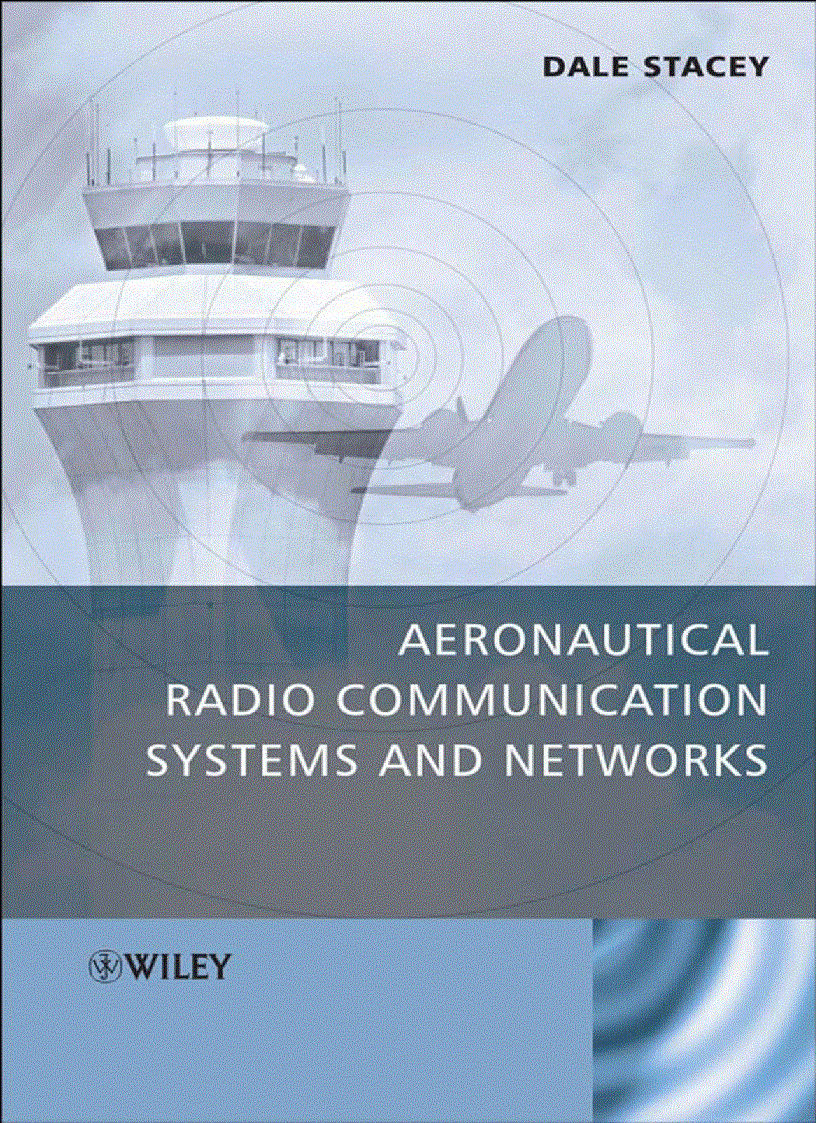
 Aeronautical Radio Communication Systems and Networks
You may ask why I wrote this book. There are many, many personal reasons as with any author I suppose. The first two reasons and probably the most important are my love of flying and my love of radio engineering. This may sound rather dull but I
pdf Đăng bởi
shop115
Aeronautical Radio Communication Systems and Networks
You may ask why I wrote this book. There are many, many personal reasons as with any author I suppose. The first two reasons and probably the most important are my love of flying and my love of radio engineering. This may sound rather dull but I
pdf Đăng bởi
shop115