
Info
<!--
/* Font Definitions */
@font-face
{font-family:"MS Mincho";
panose-1:2 2 6 9 4 2 5 8 3 4;
mso-font-alt:"MS 明朝";
mso-font-charset:128;
mso-generic-font-family:modern;
mso-font-pitch:fixed;
mso-font-signature:-1610612033 1757936891 16 0 131231 0;}
@font-face
{font-family:"\@MS Mincho";
panose-1:2 2 6 9 4 2 5 8 3 4;
mso-font-charset:128;
mso-generic-font-family:modern;
mso-font-pitch:fixed;
mso-font-signature:-1610612033 1757936891 16 0 131231 0;}
/* Style Definitions */
p.MsoNormal, li.MsoNormal, div.MsoNormal
{mso-style-parent:"";
margin:0in;
margin-bottom:.0001pt;
mso-pagination:widow-orphan;
font-size:12.0pt;
font-family:"Times New Roman";
mso-fareast-font-family:"MS Mincho";}
@page Section1
{size:8.5in 11.0in;
margin:1.0in 1.25in 1.0in 1.25in;
mso-header-margin:.5in;
mso-footer-margin:.5in;
mso-paper-source:0;}
div.Section1
{page:Section1;}
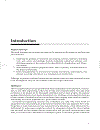
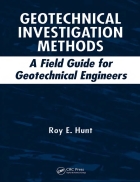
-->This book describes and provides the basis for the selection of the numerous methods and procedures for:
1. Exploring the geologic environment and mapping surficial conditions, including rock, soil, water, and geologic hazards; preparing subsurface sections; and obtaining samples of the materials for identification, classification, and laboratory testing.
2. Measurement of material properties (basic, index, hydraulic, and mechanical) in the field and laboratory.
3. Field instrumentation to measure and monitor movements, deformations, and stresses occurring naturally or as a consequence of construction. Although, in practice, analytical procedures and design criteria are often presented as part of an investigation, they are not included within the scope of this book.
Significance
The investigation phase of any geotechnical study undertaken for development, construction, or any other engineering works is by far the most important phase. Not only must conditions at the project site be thoroughly identified, but for many projects, the regional geologic characteristics must also be determined. For all phases of investigation, there are a large number of methods and devices to choose from, ranging from simple to complex, and usually several are applicable for a given subject of study. Geotechnical engineering analyses and evaluations are valid only when based on properties truly representing all of the natural materials that may influence the works. Properties of some materials are best measured in the laboratory, while others must be field tested. In some cases, properties cannot be adequately defined by direct testing and the result will be designs that are conservative and too costly, unconservative and risky, or unconservative but based on contingency plans. To monitor ground conditions during construction, field instrumentation is an important element of many studies, where subsurface conditions cannot be adequately defined by exploration and testing. Instrumentation is used also to obtain design data and to monitor changing natural conditions such as slope failures and fault movements.